















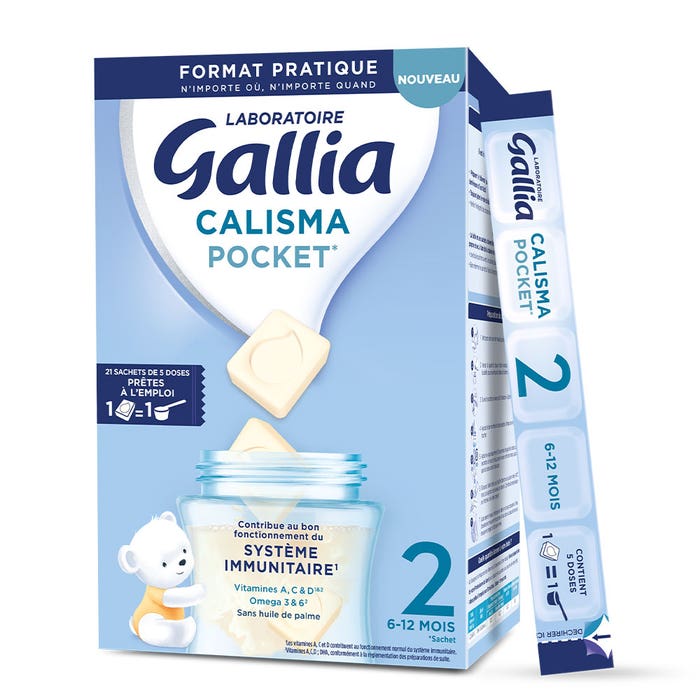
Gallia Calisma 2 Pocket powdered milk suitable from 6 to 12 months 21 Sachets of 5 Doses
- bvseo_sdk, p_sdk, 3.2.1
- CLOUD, getAggregateRating, 12.65ms
- REVIEWS, PRODUCT
- bvseo-msg: HTTP status code of 404 was returned;
Description
- Infant milk enriched with iron, vitamins and essential fatty acids for your baby
- Tailored to the nutritional needs of babies aged 6 to 12 months
- Supports brain development and strengthens the immune system
- Can be used alongside or as a supplement to breastfeeding
- Convenient individual sachets for easy, accurate dosing
- Follow-on milk, infant food – Net weight: 524 g
Gallia Calisma 2 Pocket powdered milk offers a practical, tailored solution for supporting babies aged 6 to 12 months through this important developmental stage, with special focus on their immune system. Designed specifically for the second stage of infancy, this powdered milk comes in a convenient, travel-friendly format—perfect for parents on the go.
Convenient and tailored to your baby’s needs
This Gallia Calisma powdered milk stands out with its 21 individual sachets, each containing 5 precisely measured doses. The hygienic, easy-to-use format lets you prepare your baby’s bottle quickly and effortlessly, wherever you are. Specially formulated for 6 to 12 months, it meets the nutritional requirements of this key growth phase, helping to support your baby’s natural defences. Simple to use yet uncompromising on quality, it’s designed to make daily life easier for parents who value both practicality and excellence.
A balanced diet for the second stage
The Calisma 2 Pocket formula is crafted to complement your little one’s diversified diet, providing essential nutrients during this transitional period while ensuring gentle digestion. The individual sachets prevent waste and maintain freshness, giving you peace of mind every day. Whether at home or out and about, this powdered milk adapts seamlessly to your lifestyle, offering flexibility without compromising on nutrition.
Combining ease of use with nutritional precision, this Gallia solution provides reliable support for your baby’s development month after month.
https://shop.laboratoire-gallia.com/nous-contacter
LABORATOIRE GALLIA
BSA - CS13754
81 rue de Sans Souci
69576 Limonest Cedex
0800.202.202
How to use it
How to prepare Gallia Calisma powdered milk?
Before preparing, wash your hands thoroughly and disinfect your work surface. Pour cold water into the bottle, then add the number of powdered doses indicated on the packaging. Shake until fully dissolved. To warm, use a bottle warmer or a warm water bath (maximum 40°C). After each use, clean the bottle with a suitable product and allow to air-dry.
Compositions & ingredients
The composition may be subject to variations, so we advise you to always check the list on the purchased product.
Ingredients: Lactose (MILK) – Vegetable oils (sunflower, coconut, rapeseed, in varying proportions) – Skimmilk (MILK) – Demineralised whey (MILK) – Galacto-oligosaccharides (MILK) – Concentrated whey (MILK) – Cow’s milk proteins (MILK) – Emulsifier: sunflower lecithin – Fructo-oligosaccharides – Fish oil (FISH) – Choline chloride – Mortierella alpina oil – Inositol – L-tryptophan – L-carnitine – Antioxidant: ascorbic acid fatty acid esters – Minerals (calcium and magnesium orthophosphates, potassium and magnesium chlorides, sodium and potassium citrates, calcium carbonate, iron, zinc, copper and manganese sulphates, potassium iodide, sodium selenite) – Vitamins (A, B1, B2, B3, B5, B6, B8, B9, B12, C, D3, E, K).
Important notice: Breast milk is the ideal and natural food for infants. However, if you cannot or choose not to breastfeed, your healthcare professional will recommend an infant formula tailored to your baby’s specific nutritional needs. This product is suitable for your baby’s diet; do not change it without consulting your doctor. Store the box and sachets at room temperature in a clean, dry place, away from heat and opened food.
| Nutritional information | Per 100.0 g|ml | Per 100 ml reconstituted to 14.3% |
|---|---|---|
| Energy | 1987 kJ | 285 kJ |
| Energy | 474 kcal | 68 kcal |
| Fats | 22.3 g | 3.2 g |
| of which saturates | 7.1 g | 1 g |
| Linoleic acid = LA | 3 g | 0.433 g |
| Alpha-linolenic acid = ALA | 0.4 g | 0.052 g |
| Docosahexaenoic acid | 0.06 g | 0.009 g |
| Arachidonic acid | 0.12 g | 0.017 g |
| Carbohydrates | 57 g | 8.2 g |
| of which sugars | 56.4 g | 8.1 g |
| Dietary fibre | 4 g | 0.6 g |
| of which GOS (Galacto-oligosaccharides) | 3300 mg | 480 mg |
| FOS (Fructo-oligosaccharides) | 570 mg | 80 mg |
| Protein | 9.5 g | 1.4 g |
| Vitamins | ||
| Vitamin A | 415/104 µg/%VRE* | 59/15 |
| Vitamin D3 | 12/171 µg/%VRE* | 1.70/24 |
| Vitamin E | 8.60 mg TE | 1.20 |
| Vitamin K1 | 29 µg | 4.10 |
| Vitamin C | 70/156 mg/VRE* | 10/22 |
| Thiamine (B1) | 0.35 mg | 0.05 |
| Riboflavin (B2) | 0.97 mg | 0.14 |
| Niacin (B3) | 3.10 mg | 0.45 |
| Vitamin B6 | 0.35 mg | 0.05 |
| Folates (B9) | 96 µg | 14 |
| Vitamin B12 | 1.20 µg | 0.17 |
| Biotin (B8) | 13 µg | 1.90 |
| Pantothenic acid (B5) | 3.62 mg | 0.52 |
| Minerals | ||
| Sodium | 159 mg | 22.8 |
| Potassium | 548 mg | 79 |
| Chloride | 392 mg | 56 |
| Calcium | 543 mg | 78 |
| Phosphorus | 352 mg | 51 |
| Magnesium | 51 mg | 7.3 |
| Iron | 7.10 mg | 1 |
| Zinc | 3.40 mg | 0.49 |
| Copper | 0.38 mg | 0.06 |
| Manganese | 0.04 mg | 0.006 |
| Fluoride | 0.0072 mg | 0.001 |
| Selenium | 22 µg | 3 |
| Iodine | 92 µg | 13 |
| Other nutrients | ||
| Choline | 103 mg | 15 |
Gallia Laboratory encourages breastfeeding for at least the first 6 months of a baby’s life, in line with WHO recommendations. Breast milk is the most suitable food for meeting babies’ specific nutritional needs. Regulations also prohibit infant food manufacturers from promoting formula milk for newborns (0–6 months). Always consult your doctor.
In addition to milk, water is the only essential drink.
Breast milk is the ideal and natural food for infants, perfectly tailored to their specific needs. A mother’s balanced diet is important for preparing and continuing breastfeeding. Mixed feeding may interfere with breastfeeding, and reversing the decision not to breastfeed can be difficult. If using infant formula when breastfeeding is not possible or chosen, it is essential to strictly follow preparation and usage instructions and seek medical advice.
Incorrect use could pose a risk to the child’s health. Socio-economic implications should be considered when choosing a feeding method.
Related products
-
 Gallia
Gallia Calisma First infant milk powder from birth to 6 months 800 g
Supports daily development in newborns from birth with Omega 3, including DHA.
(19)£19.01£23.76/kg -
 Gallia
Gallia Calisma Follow-up stage 1 baby milk powder suitable from birth to 6 months 800 g
Designed to complement or replace breastfeeding from birth up to 6 months.
(2)£21.94£27.42/kg -
 Gallia
Gallia Calisma First milk powder from birth to 6 months 2 x 600 g
Infant formula enriched with DHA Omega 3 to support babies’ nutrition from birth to 6 months.
(5)£27.37£22.81/kg -
 Gallia
Gallia Galliagest 1 Premium thickened infant formula suitable from birth to 6 months 800 g
Thickened infant formula with DHA, tailored to meet the nutritional needs of non-breastfed babies aged 0–6 months.
(6)£22.57£28.21/kg -
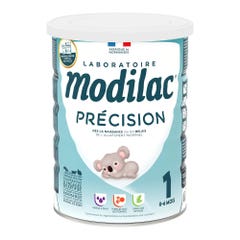 Modilac
Modilac Precision Milk Powder 1 0 to 6 months 700g
Precision 1 milk powder for babies from 0 months.
(0)£15.62£22.31/kg -
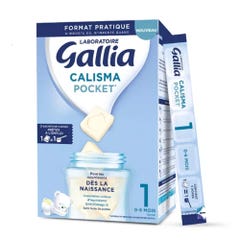 Gallia
Gallia Calisma 1 Pocket powdered milk from birth 21 sachets of 5 doses
Provides complete infant nutrition tailored to babies’ dietary needs from birth to 6 months.
(0)£18.68£38.67/kg -
 Gallia
Gallia Galliagest Premium 1 infant milk powder from birth to 6 months 1.1 kg
Supports your baby’s immune system development with a nutrient-enriched formula inspired by breast milk.
(2)£27.80£25.27/kg -
 Gallia
Gallia Calisma Relais 1 follow-up milk powder from birth to 6 months 400 g
Palm oil-free follow-on baby milk powder, designed to support infants from birth to 6 months alongside breastfeeding.
(0)£13.38£33.45/kg -
Organic Made in France
 Physiolac
Physiolac Bio Milk Dès La Naissance 0 à 6 mois 400g
The Physiolac 1er age is an infant formula powder milk, adapted both for newly borns and babies up to 6 month of age.
(1)£14.19£35.48/kg -
Made in France
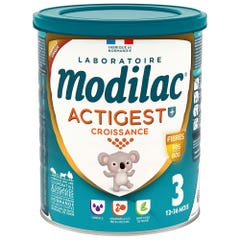 Modilac
Modilac Actigest Milk Powder 3 12 to 36 months 800g
Thickened formula milk powder for infants.
(4)£15.39£19.24/kg
Reviews
- bvseo_sdk, p_sdk, 3.2.1
- CLOUD, getReviews, 13.36ms
- REVIEWS, PRODUCT
- bvseo-msg: HTTP status code of 404 was returned; HTTP status code of 404 was returned;
Got a question?
- bvseo_sdk, p_sdk, 3.2.1
- CLOUD, getContent, 10.69ms
- QUESTIONS, PRODUCT
- bvseo-msg: HTTP status code of 404 was returned;
